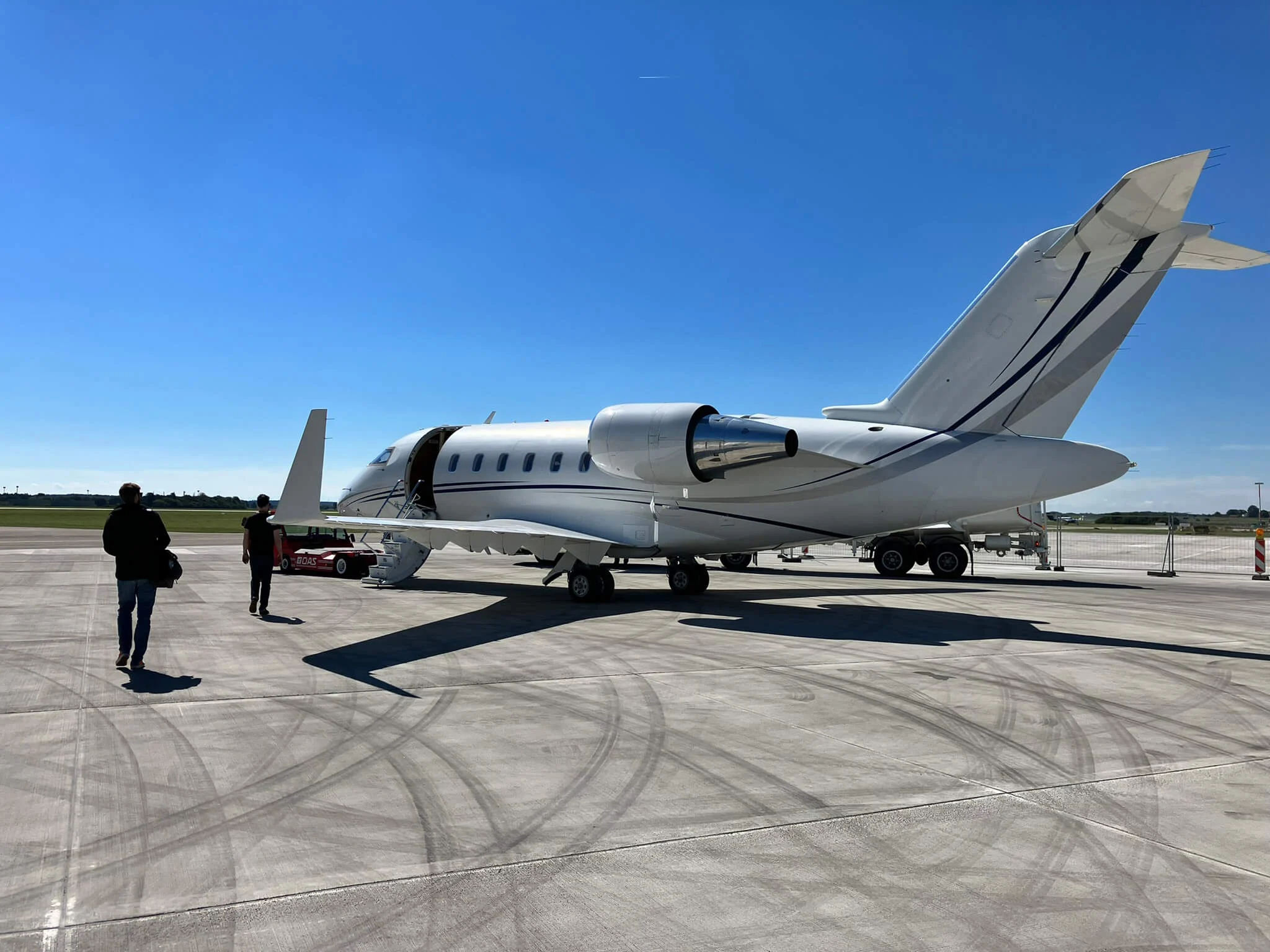
Challenger 350 & 3500
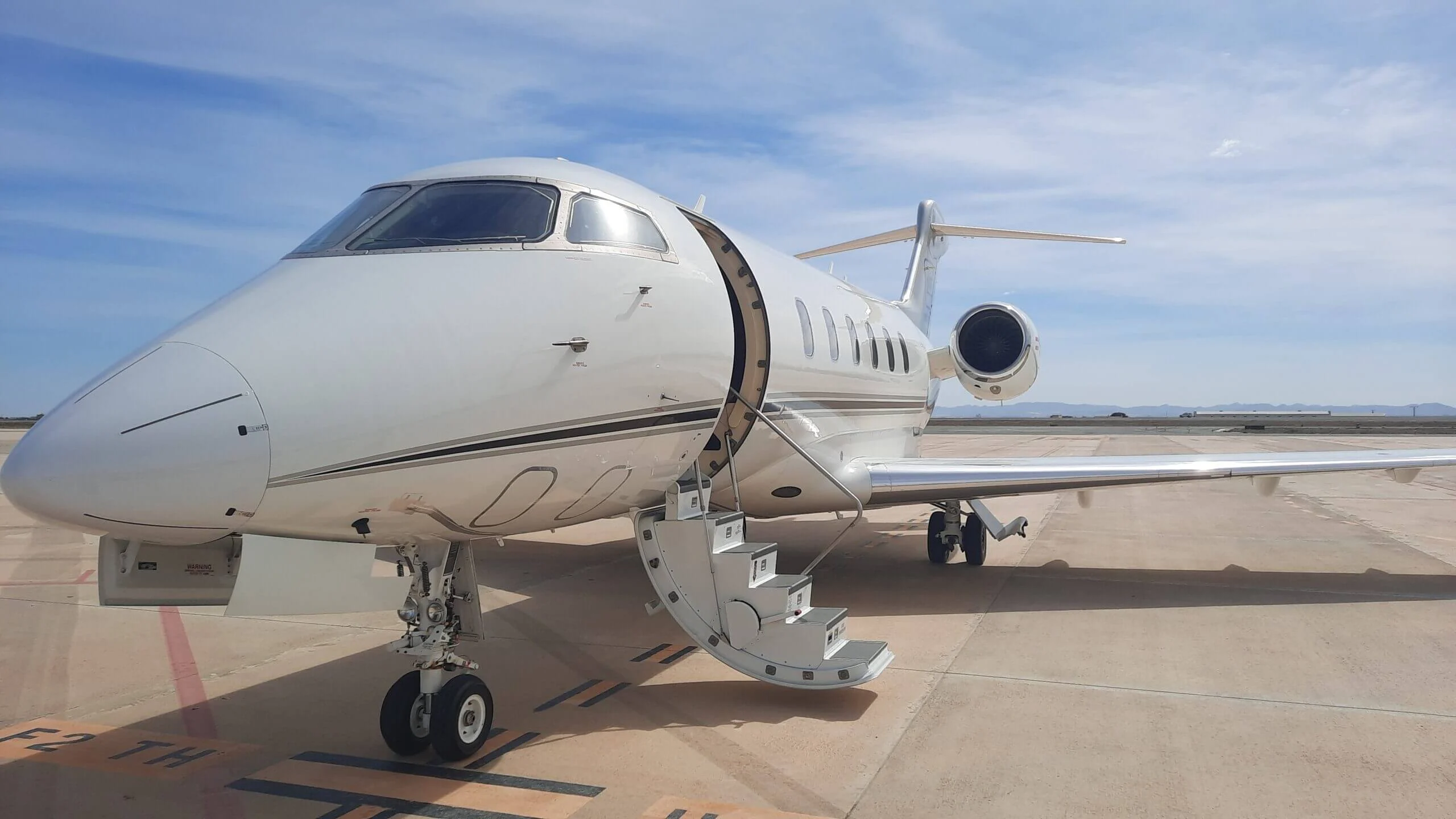
Aeroset Flight Test supported simulator development across the Bombardier Challenger super-midsize family — both the Challenger 350 and its successor, the Challenger 3500, which share the same BD-100-1A10 type certificate. The two campaigns sit at opposite ends of the flight test spectrum. The first was a full Level D simulator data campaign on the Challenger 350 comprising 26 flights over four weeks in 2023, capturing performance, handling qualities, control forces, sound, vibration and flight dynamics across the whole envelope. The second was a single, focused flight on the Challenger 3500 in 2026 to characterize the autothrottle system’s behaviour.
The Challenge
Two campaigns, two very different problems.
The Challenger 350 campaign was a large, full-envelope Level D program on a working business jet with tight availability. Instrumentation had to fit and de-fit around owner use through partial-install provisions in an EASA service bulletin. The test matrix specified more than 140 ARINC parameters across air data, inertial reference, dual FADECs, displays, stab trim and gear logic — many of which had to be validated against the airframe rather than the manual, with several planned parameters found inoperative on the serial and dropped. Crosswind-sensitive points and European weather forced repeated relocation, from Nürnberg to Granada and the Mediterranean training area LED26, finishing in Basel with diversions to Linz and Baden-Baden.
The Challenger 3500 campaign was the opposite kind of problem, not breadth, but a single new system under a hard one-day constraint. The 3500 introduced an autothrottle that the simulator developer needed real-world evidence for, and the aircraft was available for one flight only. Everything — install, flight, and the data needed to characterize the autothrottle’s behaviour and its manual override forces — had to happen in a single day, with the rig fitted in the morning and the aircraft handed back the same afternoon.
Our Approach
The 350 campaign ran on a per-flight test matrix and a handheld test card deck, with detailed pre- and post-flight briefings and a full run-note audit trail per condition. Two engineering decisions de-risked it. An in-flight pressure-port purging system, built around three-litre 200-bar dry-air cylinders, cleared the AOA and AOS ports between conditions instead of forcing a landing for a nitrogen purge; and the team used the aircraft’s own production control-force transducers in place of an external Moog system, removing a dedicated hangar day.
The 3500 flight demanded a different kind of ingenuity: How to measure a system precisely with equipment that touches nothing structural. The team built custom 3D-printed mounts — designed from a 3D scan of the cockpit and a spare throttle quadrant, and iterated until every physical interference was eliminated — to carry potentiometers on the independently-moving thrust levers. Force sensors on the thrust levers and rudder pedals captured the manual autothrottle override forces. Two GoPro cameras, one on the throttle quadrant and one on the copilot’s PFD showing the live autothrottle and autopilot modes, ran modified firmware and external timecode generators, fed through a multiview switcher to a single laptop. A custom handheld event button marked the data. The whole rig ran on battery packs and was secured with suction mounts and tape, making it entirely reversible.
To widen and cross-check the dataset, the team also requested the aircraft’s own flight data recorder output from the operator, giving N1 commands and targets, thrust-lever angles, fuel flow and air data to corroborate the instrumented measurements.
Key Activities
- Aircraft sourcing and operational coordination for both the multi-week CL350 and the single-day CL3500 test aircraft.
- Full Level D instrumentation coordination on the CL350 — Inertial Labs INS-D at the CG, pilot-seat accelerometers, AOA and AOS pressure ports with in-flight purging, ship-system tie-ins to production control, surface and force transducers, four flight deck cameras, multi-channel audio.
- 140+ ARINC 429 parameter integration on the CL350 with on-aircraft validation of each parameter.
- Loose, reversible instrumentation on the CL3500 installed and removed within a single day with no aircraft modification.
- Synchronised cockpit video on the CL3500 — two GoPro cameras (throttle quadrant and live autothrottle / autopilot mode display) with modified firmware, external Deity timecode generators and a multiview switcher.
- Manual autothrottle override force measurement on the CL3500, capturing the push and pull forces required to override the system at the thrust lever.
- FDR data integration on the CL3500 — sourcing the aircraft’s recorded N1, thrust-lever-angle, fuel-flow and air-data parameters from the operator to corroborate the instrumented dataset.
- Ground-based control force calibration on the CL350 against production transducers and a purpose-built calibration fixture..
- Flight test direction across both campaigns, with pre- and post-flight briefings, real-time data monitoring and timecode synchronisation.
- Airspace and ATC coordination — across Germany, Spain, Switzerland and Austria.
Results
The Challenger 350 campaign completed 26 flights over four weeks and delivered a full Level D data package including handling qualities, performance, control forces, flow noise and vibration, approach-to-stall and stick-pusher, banked stalls and a VMCA demonstration sequence, without a major programme-stopping event. The in-flight purge system, production-transducer control forces and corrected instrumentation choices all carried through as intended.
The Challenger 3500 flight delivered exactly what it set out to capture in its single sortie: a full autothrottle data set across takeoff, climbs in both vertical-speed and flight-level-change modes, autothrottle engagement at multiple altitude and speed targets up to FL350.